
Don't miss leadership insights
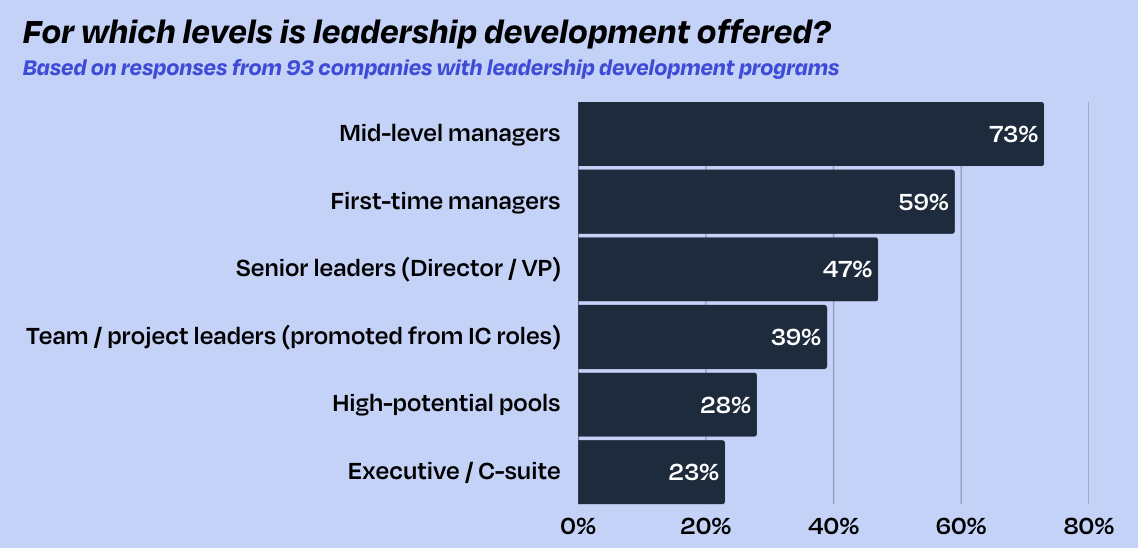
Survey data shows that leadership development is present on organizational agendas, but that this agenda varies across different levels. Seventy-three percent of organizations offer programs for mid-level managers, while 59% provide programs for first-time managers. These two groups form the core focus of leadership development.
This distribution suggests that leadership development carries not only the responsibility of managing the present, but also of preparing for the future. Investment in first-time managers reflects a strategic perspective of developing leaders “before they become leaders.”
However, another notable point stands out. Only 23% of organizations implement development programs for senior leaders. This finding implies that C-level leaders are often excluded from the development architecture or that their needs are addressed through different tools. Yet leadership development research emphasizes that evolving leadership expectations also create significant development needs at the top management level. This brings the question “to what extent does leadership development include the top?” back into focus.
When model preferences are examined, 49% of organizations are seen to run leadership development primarily through external providers. Only 13% rely entirely on internal content or in-house academies. The remaining 38% represent a hybrid model that balances sustainability with the generation of organization-specific insight.
This distribution shows that organizations still have development areas when it comes to building their own leadership capability. While external resources may offer a functional solution for many organizations, developing organization-specific leadership models and content creates deeper cultural alignment in the long term.

The prominence of leadership development is not coincidental. Research shows that leadership capacity directly shapes not only team productivity, but also collaboration environments, cultural alignment, employee engagement, change management, and organizational learning. For this reason, leadership development is no longer positioned as a “training topic,” but as a strategic building block that determines an organization’s speed of transformation and resilience.
When all these data points are brought together, the picture becomes clear. Leadership development is not merely a part of organizational learning; it is the backbone that carries it.
According to research conducted by Gallup, for 55% of CEOs the top priority is developing next-generation leaders. However, this leadership gap cannot be closed through traditional training alone.
For L&D teams, the task is no longer just to plan training, but to design transformation.
Design Transformation with Lumolead

Boost your goals with bonus insights! See more content on LumoLabs.


%20(9).jpg)
%20(4).jpg)