
Don't miss leadership insights

Research findings show that the biggest barrier to employee development is “time constraints and workload,” cited by 71% of respondents. However, this reflects not only operational pressure, but also a deeply rooted perception that learning is still positioned as an activity separate from work. This leads to the critical question: is there truly no time, or is space not created because development is still not seen as a natural part of work?
A similar situation applies to leadership development. The HBI 2025 Global Leadership Report identifies lack of time to complete training (49%) as one of the main barriers for leaders. Other challenges cited in the same report: difficulty in evaluation (49%), lack of technology integration (47%), and weak alignment with business strategies (44%) illustrate why learning struggles when it is designed separately from daily workflows. In this context, McKinsey’s 70/20/10 model provides an important frame, reminding us that 70% of learning happens through on-the-job experiences such as role rotations and new projects, 20% through social interactions like feedback, coaching, and mentoring, and only 10% through formal methods. In other words, effective learning inherently takes place at the center of work.
On the other hand, barriers such as insufficient budget (46%) and lack of motivation (43%), while appearing operational at first glance, actually reflect where organizations strategically position development. In some organizations, development is still treated as an activity undertaken “if possible,” whereas in more mature structures it is seen not as a cost, but as a cornerstone of capability-based competitive advantage. As a result, the critical question for many organizations is shifting from “What should we teach?” to “When and how will we learn?”
Ultimately, the issue is not about creating time, but about moving learning closer to the work itself. In organizations that succeed in doing so, what initially appears to be the biggest barrier—time—gradually diminishes and is replaced by a sustainable learning flow.
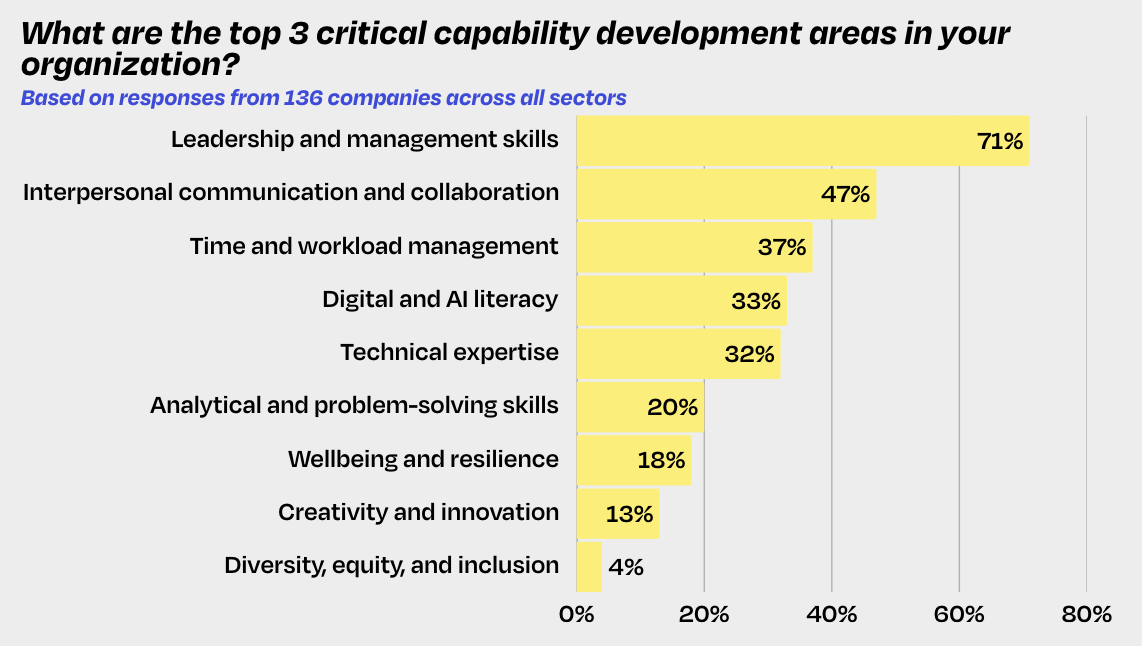
Seventy-one percent of survey participants identify leadership and management skills as the most critical development area within their organizations. This figure represents not just a preference, but a strong signal of how organizations want to prepare for the future.
Global trends confirm this picture. According to the MindGym Talent Management 2025 Report, strengthening leadership capacity is the top priority for talent managers, with 33% of participants defining leadership development as the most critical organizational development area. In an environment of increasing uncertainty and performance pressure, leaders are expected not only to manage, but to enable learning, transform their teams, and continuously trigger development. For this reason, leadership development is no longer positioned as a “skill set,” but as a transformation muscle that carries organizational culture.
The areas ranked second and third in the chart, interpersonal communication and collaboration (47%) and time and workload management (37%), are directly linked to leadership behaviors. How a leader communicates, prioritizes, and makes decisions shapes team collaboration climates, productivity, and even workplace culture. Similarly, digital and AI literacy (33%) and technical expertise areas (32%), driven by digitalization, gain meaning within ways of working shaped by leaders.
When all these data points are combined, a single message stands out: many of the capability needs organizations identify across different areas are fundamentally rooted in the transformation of leadership capacity. AI literacy, collaboration, problem-solving, innovation, even wellbeing: all of these grow or weaken depending on the environment leaders create. Therefore, this chart should be read not merely as a priority list, but as a strong signal of the leadership model organizations need for the future. And this model is no longer about “managing,” but about leaders who accelerate learning, strengthen trust, and enable change. For this reason, leadership development moves far beyond being a “capability development” area and becomes the backbone of organizational learning and transformation.
This also explains why leadership and manager development appears as the number one L&D priority for the next 12 months at 67% in the following chart. Leadership is not only a critical capability area, but the core mechanism that enables all other development priorities on the list, from technical skills to AI literacy, to be realized. The effectiveness of strategic areas such as technical or functional skill development (54%) and AI and automation capability (48%) largely depends on how managers bring these capabilities into their teams’ agendas. The high visibility of learning culture and manager enablement needs (30%) indicates that organizations recognize the need to strengthen leadership capability first in order to scale learning behaviors. In other words, leadership development is no longer just a training program; it is an investment that determines organizational resilience, agility, and competitive position in the talent market.

At the same time, a significant gap stands out. Today, 32% of companies do not have a defined leadership development program. This gap makes visible both the transformation needs of current leaders and the lack of systems to develop future leaders. As a result, leadership development becomes not just a topic placed high on priority lists, but a foundational structure that sustains organizations’ long-term talent strategies.
The conclusion is clear. No matter how much organizations invest in AI or how many technical skills they develop, the real speed of transformation is still determined by leadership capacity. Therefore, placing leadership development at the center of L&D’s future agenda is not a trend, but a natural outcome of organizations’ survival strategies.
32% percent of companies do not have a leadership development program.

Boost your goals with bonus insights! See more content on LumoLabs.
.png)

%20(9).jpg)
%20(4).jpg)