
Don't miss leadership insights
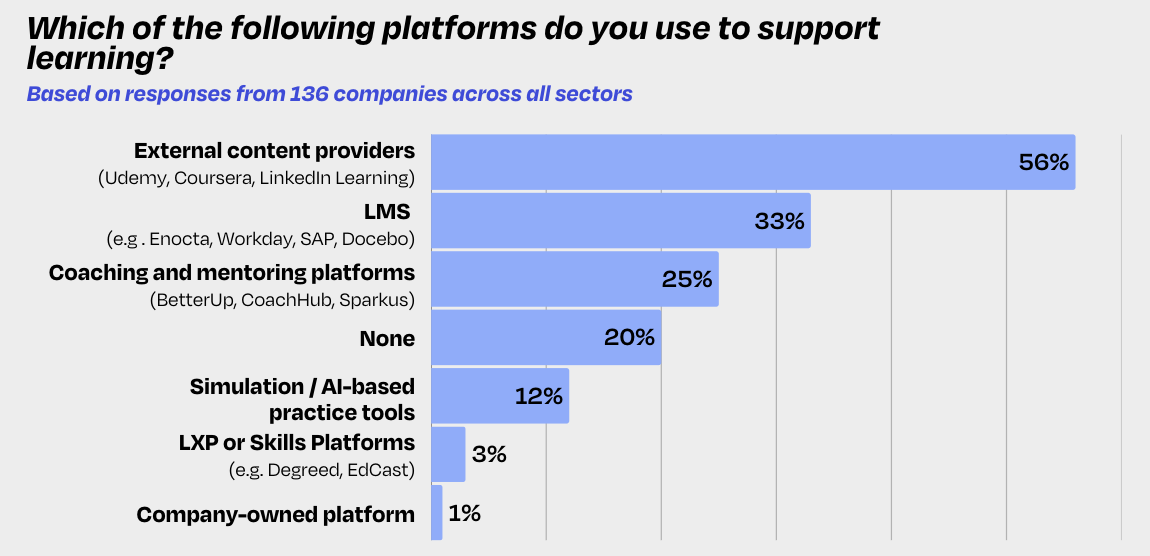
Survey findings show that organizations have built strong infrastructure for access to digital learning tools. Fifty-six percent of participants use external content providers such as Udemy, Coursera, and LinkedIn Learning, while 33% use LMS systems. This picture reveals that abundance of digital content is no longer a privilege, but the baseline of corporate learning. However, broad access alone does not create a meaningful learning experience. Today’s critical question has shifted: access exists, but what kind of experience does this access turn into?
20% of companies do not support their L&D processes with a platform
A distribution in the chart directly points to this question. The fact that coaching and mentoring platforms are preferred at a rate of 25% shows that organizations are attempting to complement their digital learning architecture not only with content, but also with human-centered interactions. In contrast, the use of LXPs or skills platforms at only 3% suggests that learning is still not fully guided, and that the transition from content discovery to content curation is still at an early stage.
Global data supports this picture. According to findings from the HBI Global Leadership Report, 46% of companies consider integration with digital tools a critical criterion when evaluating leadership development solutions, while 41% view customizable design as essential. In other words, organizations value not only “having a learning platform,” but also the connection between platforms, personalization of the learning experience, and alignment with workflows.
This search also makes structural challenges on the technology side more visible. According to SHRM’s The Many Costs of HR Software Sprawl 2024 Report, 55% of HR leaders state that their current technology solutions do not meet their needs, data is fragmented due to organizations using an average of 15–50 different HR technologies, and two-thirds of leaders believe that HR effectiveness will decline if technology is not improved. These findings explain why the digital learning experience has not yet reached the desired level of integration.
By contrast, the situation is quite different in digitally mature organizations. According to Oxford Economics & SAP data, companies that effectively use digital HR solutions make decisions 38% faster, simplify processes by 37%, reduce costs by 35.5%, and see employee turnover rates fall to as low as 15% (compared to 25% in traditional structures). This difference shows that the digital learning ecosystem is an infrastructure that transforms not only training processes, but overall business efficiency.
Taken together, this picture signals an important shift in direction. The next phase of digital learning will be defined not by owning technology, but by how that technology shapes the learning experience. Access is already strong; what matters now is contextualization, personalization, and turning learning into something that can genuinely be applied at work. In a period where employees face both content overload and time pressure, the core question organizations must answer is becoming increasingly clear: how does learning move beyond being merely accessible and become an experience that transforms behavior and business outcomes?
The answer to this question also defines where digital learning will create competitive advantage. Because what differentiates organizations now is not “how many platforms are used,” but how meaningfully those platforms are translated into a coherent learning flow.
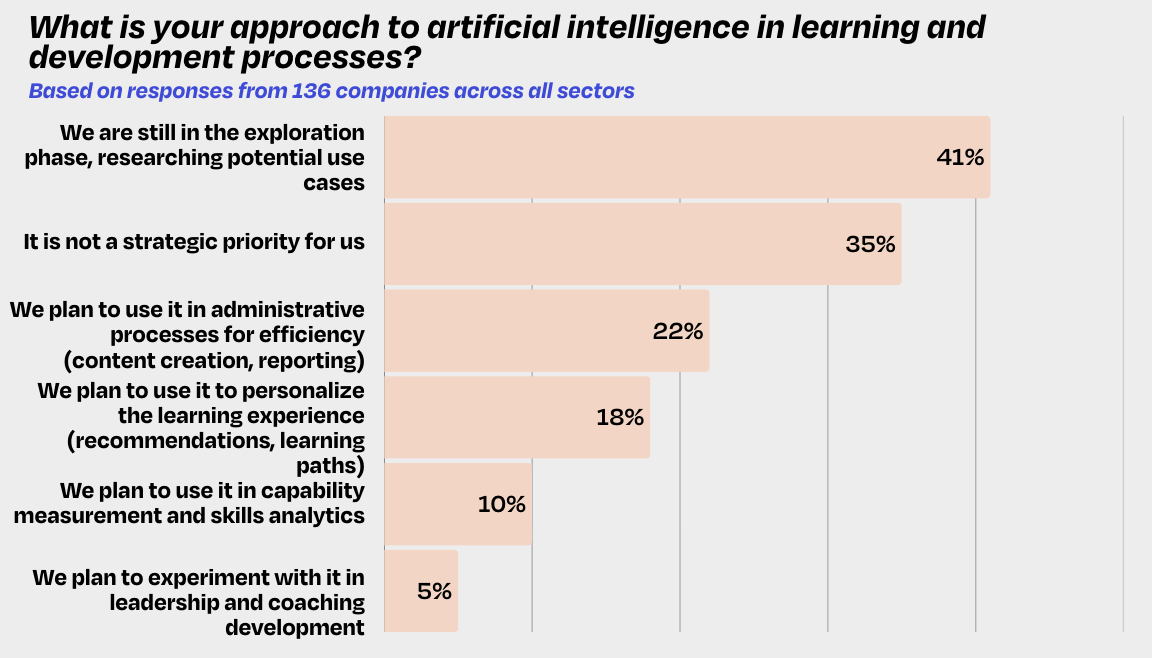
The role of artificial intelligence within L&D is steadily strengthening, yet the majority of organizations are still in an exploration phase. Forty-one percent of participants state that they are trying to understand how AI should be used. This indicates that organizations are adopting a more deliberate approach focused on identifying the right use cases, rather than rushing to implement AI quickly.
Looking at planned use cases, 22% plan to leverage AI for efficiency in administrative processes such as reporting and automated content creation, 18% for personalized learning pathways, and 10% for capability analytics. This shows that organizations are initially looking to deploy AI to reduce operational load and improve journey design.
This cautious progress aligns with global research. According to the HBI 2025 Global Leadership Report, 58% of organizations currently use AI to generate data-driven insights; in addition, 53% use AI for performance and progress tracking, and 53% for creating personalized learning pathways. Real-time support for coaching and feedback is also an emerging area, currently at 44%, with expectations that it will increase significantly with 2025 plans. These figures show that AI is beginning to touch the holistic learning experience, rather than being limited to a single function.
At the same time, L&D teams themselves are adapting personally to this transformation. According to the LinkedIn Workplace Learning 2025 Report, 71% of L&D professionals say they are actively experimenting with AI in their daily practices or integrating it into their processes. In other words, while organizational structures may not yet be mature, practitioners are already beginning to demonstrate behavioral change. So what does this picture tell us?
At this point, what is critical for organizations is matching AI technology with the right problem. The data shows that AI creates meaningful value within L&D particularly in the following four areas:
The data tells a simple story. Organizations are not yet using AI at full capacity, but they are clear on the direction: making the learning experience more personal, more contextual, and more effective. For AI to find a meaningful place within learning and development systems, it will not be about adding more technology, but about designing a more integrated learning ecosystem.
The access phase is already behind us; the real issue now is how technology transforms learning. At this point, the critical question becomes increasingly clear: to what extent will AI turn learning into a smarter, more personal, and more behavior-adjacent experience?

Boost your goals with bonus insights! See more content on LumoLabs.
.png)

%20(9).jpg)
%20(4).jpg)