
Don't miss leadership insights
A large majority of organizations today articulate a strong narrative around employee development. According to the WEF Future of Jobs Report, companies have significant expectations from their learning investments: increasing organizational productivity (77%), strengthening competitiveness (70%), and improving employee engagement (65%). In this sense, development budgets are no longer viewed as a peripheral activity, but as a strategic lever expected to directly influence business performance.
However, the extent to which these expectations translate into “reality” within organizations is closely linked to how development budgets are designed and how effectively they are utilized throughout the year. While allocating a dedicated line for learning and development in annual plans may initially signal strong ownership, this alone is not sufficient. The critical question is whether this budget is actively mobilized, or whether it ultimately turns into a statement of intent that remains partially or fully unused by year-end.

Research findings indicate that some companies allocate a company-wide development budget, while others offer a per-employee entitlement. However, what stands out is that a significant proportion still report using hybrid models or having no clearly defined approach. Organizations providing individual, per-employee budgets remain in the minority; while the shared pool approach is common, it is not always sensitive to individual learning needs. In addition, the share of organizations stating that their approach is “ad hoc” is not insignificant. This suggests that while the presence of a budget signals strategic intent, implementation has not yet reached a sufficient level of structural maturity.
Managing a highly individualized process such as employee development solely through a shared budget pool does not consistently deliver the expected impact. While it offers scale advantages, planning that does not address individual job objectives, skill gaps, or role transitions can limit the potential of the allocated budget.
The extent to which development budgets are actually utilized throughout the year provides an important indicator of how diversity in budget design translates into practice. Research results show that some organizations are able to activate their budgets only to a limited extent. In most cases, this is less about the size of the budget and more about how much space the processes that mobilize the budget are given within the organization.
There are several familiar barriers behind low utilization levels: time constraints, workload intensity, difficulties in accessing relevant content, and managers not consistently supporting learning processes. At this point, the role of managers is particularly critical. According to Bravely’s Navigating the Future of L&D / Insights and Trends (2022) study, 26% of HR leaders state that they are unable to secure sufficient senior leadership buy-in for L&D initiatives. This finding shows that budget effectiveness is shaped not only by operational capacity, but also by ownership at the leadership level.
In addition, the structural burdens HR teams face while managing budgets are also noteworthy. Findings from Oxford Economics & SAP indicate that 44% of HR budgets are spent on “not particularly critical” activities, and that especially in mid-sized organizations, legacy systems keep teams tied up in intensive operational processes. This highlights that directing resources allocated to L&D toward meaningful impact is not always straightforward.
.jpg)
When these indicators are considered together, it becomes clear that the utilization level of development budgets is not merely a performance metric, but also an indirect signal of how much space an organization truly creates for learning. Even when a budget exists, if the processes, priorities, and managerial ownership required to activate it are not clearly defined, allocated resources naturally tend to produce limited impact.

This overall picture shows that a development budget represents more than simply “money allocated for learning.” It points to something far more fundamental: the extent to which learning is embedded in organizational life. No matter how strong the strategic intent may be, how the budget is structured, how actively it is mobilized throughout the year, and how it is owned by leadership ultimately become the determining factors. The scale advantage provided by shared pools remains limited if not complemented by individual needs; similarly, even the most carefully planned budgets fail to reach their potential without managerial support or process clarity. For this reason, development budgets have become a critical area that demonstrates how organizations translate future vision into operational reality. Organizations that are effective differentiate themselves not by increasing budgets, but by turning budgets into learning environments where they can truly function. Ultimately, what enables sustainable performance is precisely this: an organizational approach that takes ownership of resources, clarifies processes, and creates space for learning within everyday work
Beyond designing the budget correctly, the accessibility and inclusiveness of learning resources are among the key factors shaping an organization’s learning capacity. At this point, a critical question emerges: who does the allocated budget actually reach, and how are learning opportunities distributed within the organization?
The data shows that structured, role-based learning pathways are largely absent across organizations. While 60% of participants state that such pathways do not exist, only 15% report that these pathways are available to all employees. This picture indicates that learning in most organizations still progresses at the level of individual effort and managerial goodwill, rather than being translated into a formal organizational architecture.

A similar concentration is observed when examining who receives structured L&D support. Although 39% of organizations report providing equal support to all employees, mid- and senior-level managers (17%), technical roles (13%), and HiPo employees (11.8%) receive more structured support. This distribution suggests that learning is treated less as an organizational right and more as a strategic investment targeted toward specific positions.
As a result, when a structured learning architecture is not established, it becomes unclear who learning opportunities reach, and strategic investments fail to generate the expected impact. The real power of learning lies not only in the content offered, but in who receives it, when it is delivered, and in what context.
Another important point to highlight here is the chain of responsibility within the learning process. Competency development is often left to individual motivation or incidental opportunities. However, for learning to evolve into an institutionalized system, role definitions, responsibilities, and ownership need to be clearly articulated.
.jpg)
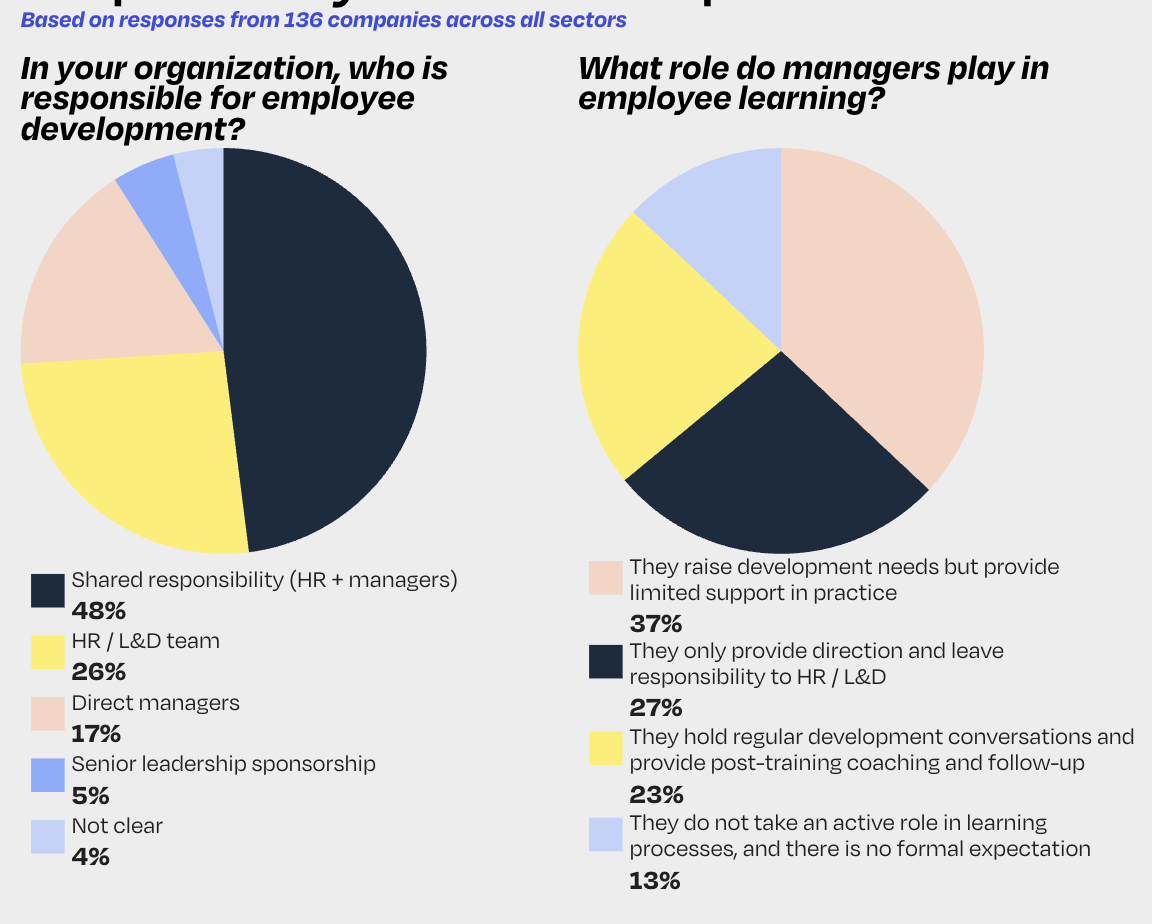
Findings related to the design and utilization of development budgets clearly show how much space organizations create for learning. However, beyond budgets, there is another equally important element: who these learning opportunities reach within the organization, how they are accessed, and according to what logic. At a certain point, the question naturally shifts here: who owns organizational development: the organization, managers, or the individual employee?
The data indicates that this question has not yet been clearly resolved within organizations. The lack of systematic learning pathways leads development to progress largely through individual effort and managerial initiative. In such an environment, employees increasingly assume responsibility themselves; according to the PwC Workforce report, 74% of employees believe that updating their skills is their own responsibility. While this individual ownership is important, its impact remains limited without strong organizational structures and managerial support. In other words, employees are internalizing learning expectations at an increasing rate, but the supporting organizational systems are not evolving at the same pace.
When examining who receives structured L&D support, this tension becomes even more visible. While 39% of organizations state that they provide equal support to all employees, mid- and senior-level managers (16.9%), technical roles (12.5%), and HiPo employees (11.8%) receive more structured support. This picture suggests that learning is positioned not as an employee entitlement, but as an investment directed toward selected roles.
A similar pattern is observed on the leadership side. Ownership of learning responsibility within the organization remains unclear. Only 23% report that managers regularly engage in development conversations with employees and provide coaching, while a significant portion offer only surface-level support or take on no role at all. This points to a gap where individual learning effort fails to meet institutional support. Data from the LinkedIn Workplace Learning Report 2025 further shows that this gap has widened over the past year: the share of managers encouraging employees to allocate time for learning has declined from 35% to 30%, support for learning new skills has dropped from 28% to 23%, and recommendations of learning materials have decreased from 25% to 18%.
From an organizational standpoint, the pattern remains consistent. When examining barriers to career development, LinkedIn Workplace Learning Report 2025 data indicates that 50% of respondents believe managers lack sufficient capability to provide support, 45% say employees are not adequately supported, and 33% report that talent teams lack the necessary capacity. Leadership unwillingness does not appear among the top three barriers, suggesting that the issue stems more from system design than from intent.
This structural gap is reflected not only in day-to-day practices, but also in how organizations design their learning and capability development strategies. Even in organizations that prioritize career development, a strong analytical and managerial collaboration is required for learning systems to function effectively. Data from the LinkedIn Workplace Learning 2025 report shows that only about half of organizations are able to track skill gaps using internal data (49%), similarly only 48% have established clear career pathways, and 45% are able to align development programs with business strategy in collaboration with managers. These figures indicate that learning architecture has not yet been fully institutionalized, and that despite strong intent, structures and processes continue to lag behind in many organizations.
When these two perspectives are considered together, the picture becomes clear. While employees increasingly perceive learning and skill development as their own responsibility, organizations struggle to take systematic ownership of learning. As a result, learning is promoted, but not yet fully owned at the organizational level.
When systems are not in place, it becomes unclear who learning opportunities reach. When roles and responsibilities remain undefined, development processes rely on individual motivation and incidental opportunities. Yet the real impact of learning is shaped not by content alone, but by context, processes, and ownership. For this reason, redesigning organizational learning architectures requires clear answers to key questions: who is learning what and why, who owns the process, and where it begins and ends.
Without clear answers, investments remain limited to well intentioned initiatives rather than enabling structural transformation. The next critical step is to assess whether these efforts create value, and how learning and development investments translate into organizational performance and measurable impact.

Boost your goals with bonus insights! See more content on LumoLabs.
.jpg)

%20(9).jpg)
%20(4).jpg)