
Don't miss leadership insights

The way to understand whether a development budget is designed effectively ultimately comes down to a single question: where, how, and to what extent does learning create value within the organization? The true impact of a program is not defined by how many people participate, but by how meaningfully it informs organizational decisions.
Research findings show that while organizations do measure learning outcomes, these measurements often translate only minimally into strategic processes. Fifty-one percent of respondents measure success through participation rates, and 49% rely on satisfaction scores. By contrast, more strategic indicators such as behavior change (38%), improvement in business outcomes (35%), and financial ROI (5%) are tracked far less frequently. This gap points to a space where the “value” of learning is felt, but its “impact” is not made visible.
This is not merely a local observation; global research confirms the same pattern. According to WEF Future of Jobs 2025 data, 77% of organizations expect productivity gains from training investments, 70% expect improved competitiveness, and 65% expect higher employee retention. Despite these expectations, measurement approaches still rely predominantly on surface-level metrics. In short, organizations expect strategic outcomes, but the measurement infrastructure required to make those outcomes visible has not yet reached the same level of maturity.
.jpg)
This gap becomes even more apparent when examining how L&D outputs feed into organizational decisions. Only 26% of responses indicate that development outcomes are regularly used as a data point in promotion decisions, career transitions, and performance evaluations. Twenty-seven percent track these outputs merely as participation indicators, while 24% do not evaluate them at all. This picture shows that in many organizations, learning is still positioned as a “supporting activity”; strategic impact emerges only when learning outputs actively inform decision mechanisms.
When this issue is reflected in performance management processes, the situation becomes even more critical. Only 29% of participants state that performance evaluations directly shape development plans. In 38% of organizations, managers may raise development topics, but the process is not systematic; in 25%, performance and development progress entirely separately.
The global perspective reinforces this view. According to McKinsey & Company’s HR Monitor 2025, based on HR interviews conducted in Europe, only 20% of organizations effectively connect performance management outputs with L&D processes. Yet most of the outcomes organizations expect productivity, competitiveness, and engagement remain largely invisible unless this connection is strengthened.
Measurement is critical for understanding learning impact; however, how measurement is conducted directly reflects organizational maturity. Leadership development provides a strong reference point in this regard. According to findings from the HBI Global Leadership Report 2025, organizations have begun using far more advanced data sets to evaluate leadership impact. Employee surveys (62%), 360-degree feedback (60%), development indicators (57%), and non-financial performance outcomes (50%) are now widely tracked.
The use of AI has also become an important part of this measurement approach. Fifty-eight percent of organizations use AI to generate data-driven insights, while 53% leverage AI to measure and track progress. These figures are expected to increase in the coming period.
These examples show that organizations are no longer satisfied with simply asking whether learning has occurred. The real question has shifted to this: what kind of change has learning created within the organization?
When all these data points are considered together, a clear conclusion emerges. Unless learning strategies are connected to performance, they create value primarily for individuals, not for the organization. Leading companies, however, view development not as an “additional function” but as a performance lever that sustains business continuity and strengthens competitive capacity.
Three core transformation areas stand out in this context.
In short, the true power of development programs lies not in content, but in their visibility within organizational decision mechanisms. When performance and learning do not meet at the same table, both remain below their potential. For this reason, one of the most practical ways to assess how effectively an organization manages learning investments is to examine how those investments translate into business decisions. As the need for performance and learning to sit at the same table becomes increasingly clear, the next inevitable question emerges: how can we tell whether learning is truly translating into work outcomes?
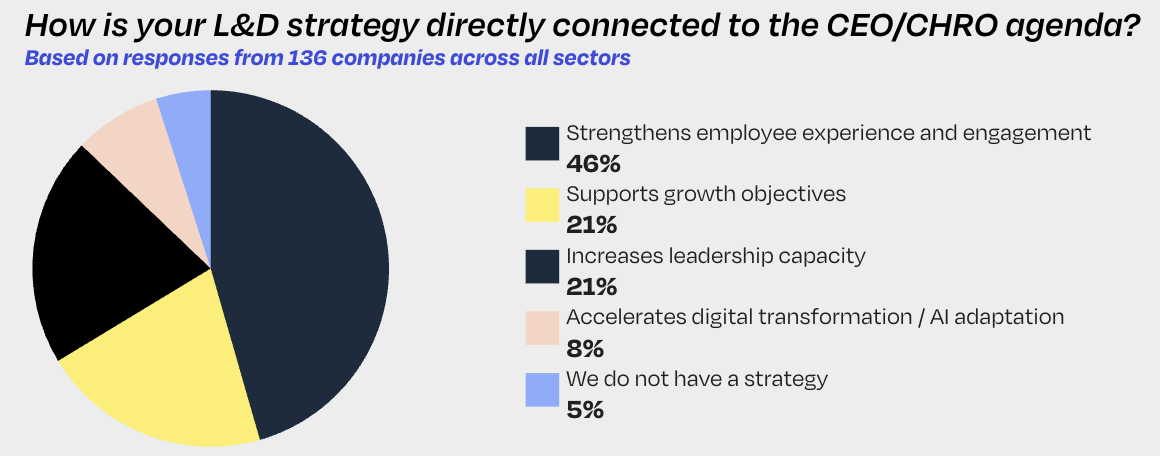
After discussing how learning is designed, measured, and linked to performance, the question naturally shifts to governance: how is this strategy anchored in the organization’s top agenda? Because the real impact of L&D emerges through its alignment with the organization’s strategic priorities.
Research findings show that employee development is no longer viewed solely as an “HR initiative,” but as a transformation area that has secured a place in senior-level governance. 46% of participants state that L&D strategies are directly connected to the CEO and CHRO agenda. In other words, development, engagement, performance, and cultural transformation are now monitored at the highest organizational level. Two separate groups, each representing 21%, emphasize that L&D supports growth objectives and leadership capacity.
A similar pattern appears in global research. In LinkedIn’s Workplace Learning Report 2025, organizations identified as “Career Development Champions” reach a 45% rate of aligning skill development programs with business strategy through close collaboration with managers and senior leaders, compared to 32% in other organizations. This indicates that organizations with higher maturity levels have made positioning learning at the center of strategy a standard practice.
However, strategic ownership has not eliminated inconsistencies in practice. In our research, only 39% state that development opportunities reach all employees equally. The limited availability of programs for technical roles, new managers, and high-potential employees indicates that the connection between L&D and talent management still requires strengthening. Moreover, only 5% of organizations identify managers as the primary owners of development, suggesting that development remains centrally managed and that managerial ownership has not yet been fully internalized.
This picture highlights 3 core focus areas. First, development opportunities need to be distributed more evenly across roles and levels, as unequal access limits the strategic impact of L&D. Second, governance structures need greater clarity. As long as role ambiguity persists between L&D teams, managers, and employees, development processes remain constrained by individual effort. Finally, learning objectives must be more strongly linked to business goals. Development becomes a true transformation lever only when it is embedded in the organization’s strategic agenda. When these areas are strengthened, L&D evolves from a function that delivers training into an architecture that carries the organization’s competitive strength and transformation capacity.

Our research shows that 65% of participants state that the most important factor in learning programs is direct applicability to work and business outcomes. This finding clearly demonstrates that organizational learning is no longer positioned as a “knowledge transfer process,” but as an infrastructure for value creation.
Today, learning investments are measured not only through individual development, but through business transformation. The translation of knowledge into behavior, and behavior into performance, in other words, learning’s tangible reflection in daily workflows has become the primary responsibility of learning design. For this reason, programs increasingly stand out not for theoretical content, but for their ability to offer workflow-integrated, timely, and contextual solutions.
When learning formats are examined, leadership- and coaching-supported learning (49%) and flexible, interactive models (32%) draw particular attention. However, the value of these tools is again defined by the strength of their connection to work. Similarly, the measurability of learning outcomes (32%) reinforces organizations’ need to make impact visible.
The relatively low importance assigned to mechanisms that support learning continuity (15%), which rank lowest in the chart, creates an interesting contradiction. While organizations prioritize factors that increase impact such as applicability, coaching, and measurement, they do not sufficiently prioritize follow-up and reinforcement steps that ensure lasting transformation.
The overall trend is clear: organizations are no longer looking for “training for the sake of training,” but for learning solutions that build skills, change behavior, and directly translate into business outcomes. Applicability has therefore become a new KPI, because real value is measured by how learning is brought to life in the workplace.

Boost your goals with bonus insights! See more content on LumoLabs.
.jpg)

%20(9).jpg)
%20(4).jpg)